
This website contains imagery that is only suitable for audiences 18+. Any surgical or invasive procedure carries risks.
Home » Diastasis Recti Repair
Pregnancy and significant stretching of the abdominal wall can leave the abdomen looking more rounded or feeling less supported. These changes may remain after childbirth, even when body weight and general fitness have otherwise returned to their previous levels. They may also cause lower back pain or urinary incontinence.
At COSMEX, diastasis recti repair may be performed as part of an abdominoplasty when the separation is accompanied by loose abdominal skin. A consultation with a Specialist Plastic Surgeon allows the abdominal muscles, supporting tissue and overlying skin to be assessed together before surgery is recommended.
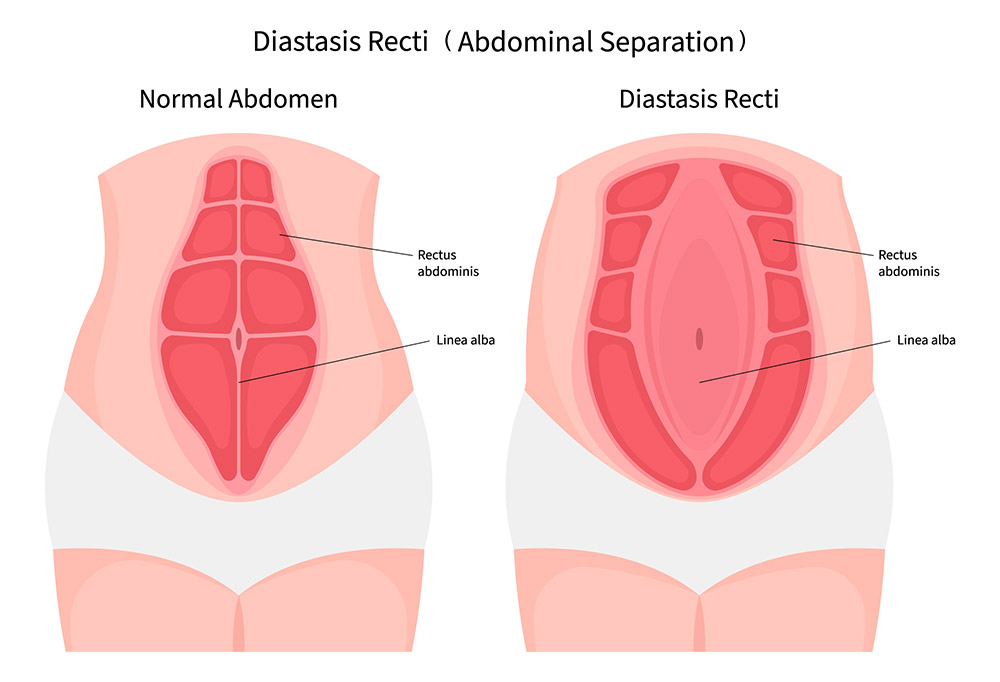
Diastasis recti is a widening of the space between the left and right rectus abdominis muscles, which run vertically down the front of the abdomen. It develops when the connective tissue along the abdominal midline, known as the linea alba, stretches and loses some of its previous tension.
The condition does not mean that the abdominal muscles have torn apart. It is also different from a hernia, although the two can occur together. Diastasis recti may affect the contour and support of the abdominal wall without creating the distinct opening associated with a hernia.
Abdominal separation can vary in its width, depth and location. For some people, the main concern is a visible change in abdominal contour, while others notice reduced support or difficulty engaging their core muscles.
Signs associated with diastasis recti may include:
Pregnancy is one of the main reasons diastasis recti develops. As the uterus expands, the abdominal wall stretches to accommodate it. Hormonal changes and increased abdominal pressure can also affect the connective tissue that holds the rectus muscles together.
The extent of the separation can be influenced by multiple pregnancies, carrying more than one baby, changes in body weight, tissue elasticity and individual anatomy. Diastasis recti can also occur in people who have not been pregnant, particularly where the abdominal wall has experienced repeated or sustained internal pressure.
Your Specialist Plastic Surgeon will assess the abdominal wall while it is relaxed and while the muscles are engaged. The examination considers the width, depth, and location of the separation, along with the condition of the abdominal skin, the position of the umbilicus, and the distribution of underlying tissue. Imaging such as an Ultrasound or CT scan may be used to further investigate diastasis recti.
Your medical history, previous pregnancies, weight changes, existing scars and plans for further children will also be discussed. If the examination suggests a hernia or another medical concern, we may recommend further investigation or referral before making a surgical plan.








Surgical treatment depends on the extent of the separation, the condition of the abdominal skin and the changes identified during examination. When diastasis recti is accompanied by loose skin, an abdominoplasty may address both concerns in the same procedure.
During an abdominoplasty, the stretched tissue over the abdominal muscles can be tightened using sutures, a technique known as plication. Excess skin is then removed, and the abdomen is reshaped. Abdominal wall repair is performed in selected cases and is not automatically included in every abdominoplasty.
Your treatment plan will be based on a physical examination, your medical history and the changes identified across the abdominal wall. Your surgeon will explain the proposed technique, expected scarring, recovery requirements, potential risks and limitations before you decide whether to proceed.
Your consultation will include an assessment of the muscle separation, skin laxity, abdominal contour and any existing scars. Your surgeon will also discuss your general health, previous pregnancies, future pregnancy plans and the changes you would like to address. This information helps determine whether an abdominoplasty with abdominal wall repair is appropriate.
Abdominoplasty with abdominal wall repair is performed under general anaesthesia in a licensed, accredited hospital. A low horizontal incision allows the surgeon to access and tighten the stretched tissue over the abdominal muscles before removing excess skin. The umbilicus may also need to be repositioned, depending on the amount of skin being treated and the surgical technique used.
Swelling, bruising, tightness and reduced mobility are expected during the early recovery period. A compression garment may be recommended, and some cases may require temporary drains. Lifting, strenuous exercise and direct abdominal training will need to be restricted while the repair heals, with activity reintroduced gradually under your surgeon’s guidance.
Changes in abdominal contour and support become easier to assess as swelling settles. The surgical scar will remain but should soften and fade over time, though its final appearance varies by patient. Future pregnancy, substantial weight changes and changes in tissue quality can affect the abdominal wall after surgery.
Diastasis recti surgery requires careful assessment of both the abdominal wall and the overlying skin. At COSMEX, we plan your procedure around your anatomy, health, and individual circumstances, with clear information throughout the surgical process.
Your assessment and procedure are carried out by a Specialist Plastic Surgeon with training in abdominal contouring and reconstructive techniques. Your surgeon will explain the examination findings, the proposed approach and the limitations of surgery so that you can make an informed decision.
Diastasis recti is assessed alongside skin laxity, abdominal tissue, existing scars and the possibility of a hernia. Considering these features together helps determine whether an abdominoplasty with abdominal wall repair is suitable for the changes present.
Abdominoplasty procedures are performed under general anaesthesia in licensed, accredited hospitals in Sydney. These facilities operate in accordance with Australian standards for anaesthesia, infection control, theatre safety and emergency care.
Postoperative care includes scheduled reviews to monitor the incision, swelling and progress of the abdominal wall repair. You will receive guidance on compression garments, movement, lifting and the gradual return to exercise as your recovery progresses.
A consultation with a Specialist Plastic Surgeon can help determine whether diastasis recti is contributing to the changes in your abdominal contour and whether surgery is appropriate. To arrange an assessment at COSMEX in Sydney, book online via our website.
Some people notice a gap or raised ridge along the abdominal midline when lifting their head and shoulders from a lying position. A self-check cannot determine the depth of the separation, the condition of the supporting tissue, or whether a hernia is present, so a clinical assessment is more reliable.
No. Diastasis recti involves widening and thinning of the tissue between the rectus muscles, while a hernia occurs when tissue pushes through an opening or defect in the abdominal wall. The two conditions can occur together and may require different treatment.
Exercises may improve core control, movement and abdominal support, particularly when guided by an appropriately qualified healthcare professional. However, they cannot remove excess skin and may not fully correct a wide or established separation.
Weight loss may reduce abdominal fat, but it does not directly restore tension to stretched connective tissue. It can also make loose skin more apparent, which is why the abdominal wall and skin need to be assessed separately.
Surgery may be considered when the separation remains significant and is accompanied by loose abdominal skin or changes that cannot be addressed through exercise alone. Suitability depends on your anatomy, health, symptoms and plans for future pregnancy.
No. Abdominal wall repair is performed when a clinically relevant separation is identified, and plication is considered appropriate. Your surgeon will examine the abdominal wall and explain whether repair forms part of the proposed procedure.
A future pregnancy can stretch the abdominal wall and affect the changes achieved through surgery. Patients are therefore generally advised to consider delaying diastasis recti surgery until they are not planning further pregnancies, although individual circumstances can be discussed during consultation. It is possible to still go through a pregnancy after abdominoplasty and diastasis recti repair although this may stretch the repair and require further tightening later.
When repair is performed as part of an abdominoplasty, it usually leaves a horizontal scar across the lower abdomen and, in many cases, a scar around the umbilicus. The length and position of the scars depend on the amount of skin being removed and the surgical technique required.
The repair is intended to restore tension through the abdominal midline, but no surgical result can be guaranteed to remain unchanged. Pregnancy, substantial weight fluctuation, tissue ageing and increased abdominal pressure may affect the repair over time.
A Medicare benefit may apply when an abdominoplasty for pregnancy-related rectus diastasis meets the relevant Medicare Benefits Schedule criteria. If patients have cover for the relevant item numbers in their private health insurance then the hospital fee may be covered by the health fund and they may be eligible for rebates on the surgical and anaesthetic costs.Eligibility must be assessed individually and may require documented symptoms and clinical measurements. Medicare eligibility does not necessarily cover all surgeon, anaesthetist and hospital costs. The eligibility criteria for item number 30175 is as follows:
Radical abdominoplasty, with repair of rectus diastasis, excision of skin and subcutaneous tissue, and transposition of umbilicus, not being a laparoscopic procedure, if:
(a) the patient has an abdominal wall defect as a consequence of pregnancy; and
(b) the patient:
(i) has a diastasis of at least 3cm measured by diagnostic imaging prior to this service; and
(ii) has either or both of the following:
(A) at least moderately severe pain or discomfort at the site of the diastasis in the abdominal wall during functional use and the pain or discomfort has been documented in the patient’s records by the practitioner providing the service;
(B) low back pain or urinary symptoms likely due to rectus diastasis and the pain or symptoms have been documented in the patient’s records by the practitioner providing the service; and
(iii) has failed to respond to non-surgical conservative treatment, that must have included physiotherapy; and
(iv) has not been pregnant in the last 12 months.
Whether you are exploring surgery, seeking a second opinion, or simply have questions
about the process, our team is here to guide you.
Call now to speak directly with our team and book a consultation.
Complete our enquiry form and our team will be in touch to guide you through your options and answer any questions you may have.
Schedule a no-obligation phone consultation with our patient concierge team, pricing guidance and any questions you may have.
Use the link below to book non-surgical appointments with our cosmetic practitioners.